Bloodrites
- Genre: 3D Action RPG
- Type: Blockout
- Engine: Unreal Engine 5
- Tools: Blueprints, Miro, Flexible Combat System
- Iterations # 6
- Playtests # 10+
- Role: Level designer (research and concept, blockout, scripting, encounter design, story)
- Playtime: ~40 minutes
Overview
Goal
My goal was to create a compelling Third-Person ARPG Dungeon with a horror atmosphere. To accomplish this, I mixed elements from the Survival Horror and RPG genre to create an experience that uses strong environmental storytelling and horror pacing to enhance the moment to moment gameplay.
Throughout my development process I focused on fast iterations, pacing, and visual storytelling to create an experience where gameplay feels impactful and tells a story through its environment.
My main goals were to:
- Improve my rapid prototyping skills
- Practice pacing through a large level with set pieces
- Create multiple areas that feel connected to the story, but have unique environments
- Use both Survival Horror and RPG design techniques in a level that feels like a mix of both
Level Overview & Technique Highlights
Level Flythrough
Setting/Synopsis: This level takes place in a chapel and a series of catacombs hidden beneath it. On the player’s journey, they are tasked to enter the chapel, find the cause of the undead infestation, and stop it at all costs.
My core design philosophy was to identify what emotion I wanted to evoke from players, then used a mix of techniques achieve that goal. Some notable technique examples I used are listed below.
- I used hub progression with environmental unlocks to evolve the player’s relationship with the space over time, revealing previously inaccessible locations and making each revisit feel meaningful.
- I subverted expectations by establishing strong visual language, then twisting it in order to build anticipation and keep players guessing.
- Inspired by Friends episodes nomenclature (i.e. “The One with the Videotape”), I scripted fun, cinematic moments with unique sequences that playtesters accurately describe as “the area with the….”
Technique Highlight 1: Hub Progression
Technique & Use-Case: As players progress through a game, their central hub also evolves with them, reinforcing that sense of progression.
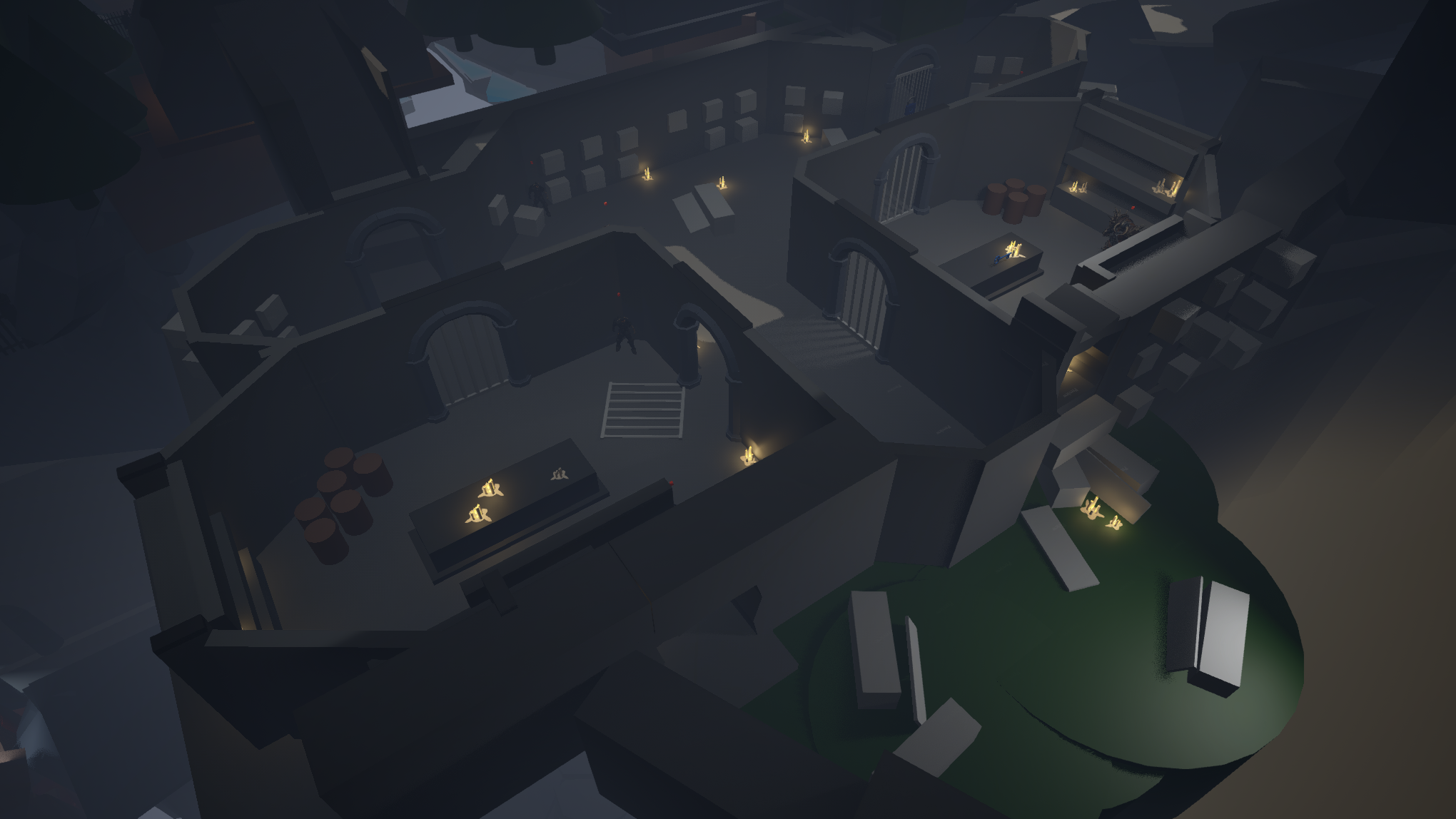
Context of Use-Case: The chapel is the central hub for the level and was designed around layered spatial progression, where repeated visits to the chapel gradually reveal new routes, shortcuts, and optional spaces through player discovery and quest-driven gating.
Technique Detail:
- The First Approach: When they first arrive, the chapel is locked
- “Finally, a way in”: Most of the rooms are locked, but the quest to enter the chamber behind the altar kicks off
- The First Return: This opens up the west wing of the chapel and teases a locked tomb
- The Second Return: Unlocks the secret chamber behind the altar, revealing a large underground garden and the final boss arena
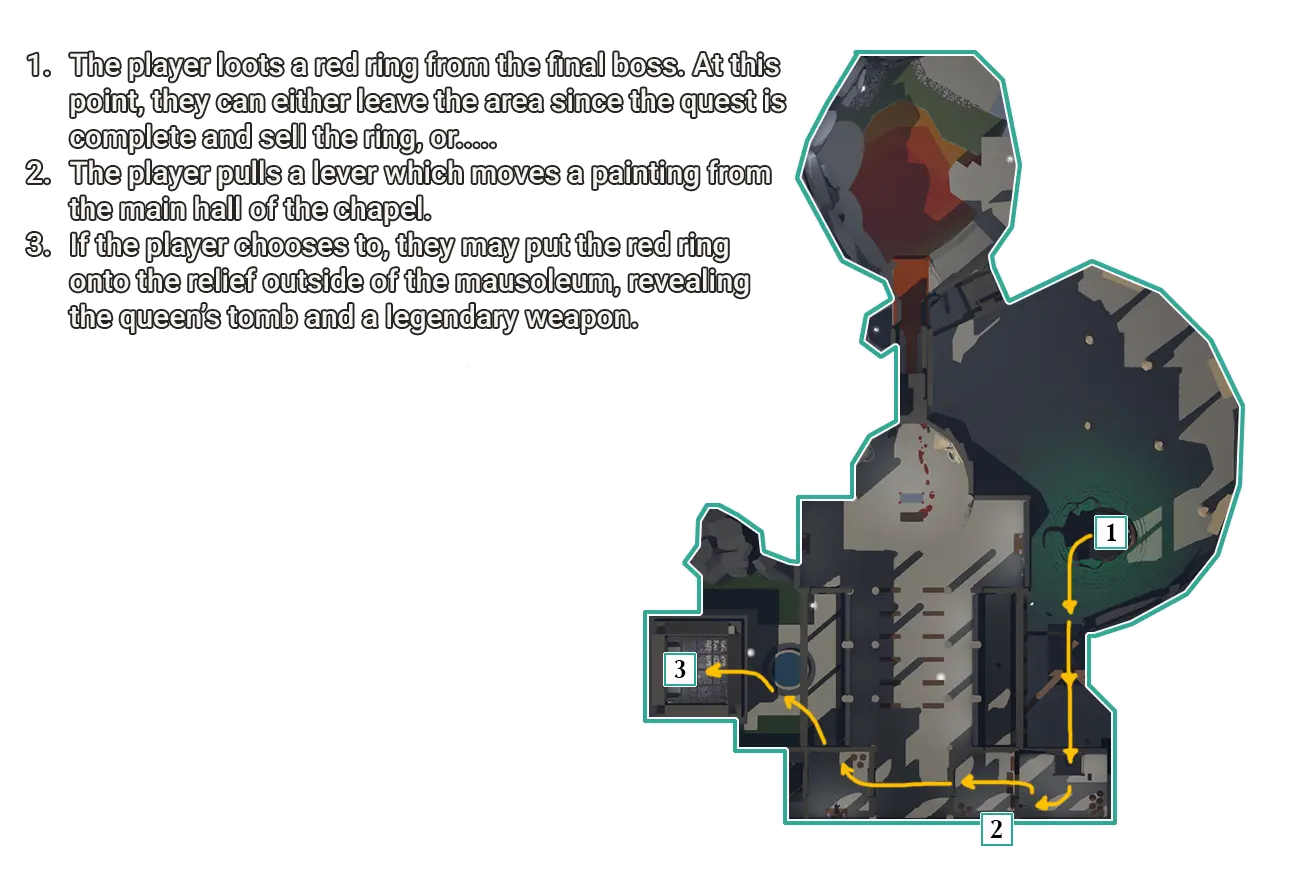
- Bonus Reward: The final boss drops a red ring which unlocks the queen’s tomb, rewarding players with a legendary weapon
Technique Highlight 2: Subverting Expectations
Technique & Use-Case: Subverting expectations is used to provide new meanings to old ideas, build anticipation, and surprise the player. Silent Hill f uses this to a great extent turning beautiful imagery, like flowers, into nightmares.
Context of Use-Case: Drawing inspiration from games that fit the aesthetics I was trying to achieve, I adopted design cues I felt players would be familiar with then twisted them in subtle ways.
Technique Detail:
- Breadcrumbs Become Traps: I entice players with easy item pickups, only to be ambushed by a scripted event
- Chiaroscuro: I balanced the dark catacombs with naturally lit open areas to give players rest spots
- Beauty in Horror: I mixed in serene areas after high intensity sequences so players don’t become numb to the horror
Technique Highlight 3: Cinematic Moments
Technique & Use-Case: Quick beats that break up the pacing and add memorable moments that leave an impression with players – I was heavily inspired by Resident Evil 9 and Signalis.
Context of Use-Case: Whether it’s introducing new characters or creating a sense of urgency or surprise, I orchestrated unique scripted events to enhance the moment to moment gameplay.
Technique Detail:
- First Miniboss: This boss leads the player towards them, only for them to fall into a cave below. The player needs to proceed through a tight wall that bursts with hands of the undead.
- Second Miniboss: The second miniboss bursts through a wall, and grabs what one would expect to be another enemy to confront, conveying an immediate sense of intimidation.
- The Scythe Door: I used funeral rites as keys, including a scythe which is re-purposed as a lever to rip through the door and tear it in half, leading to a blood waterfall.
Walkthrough
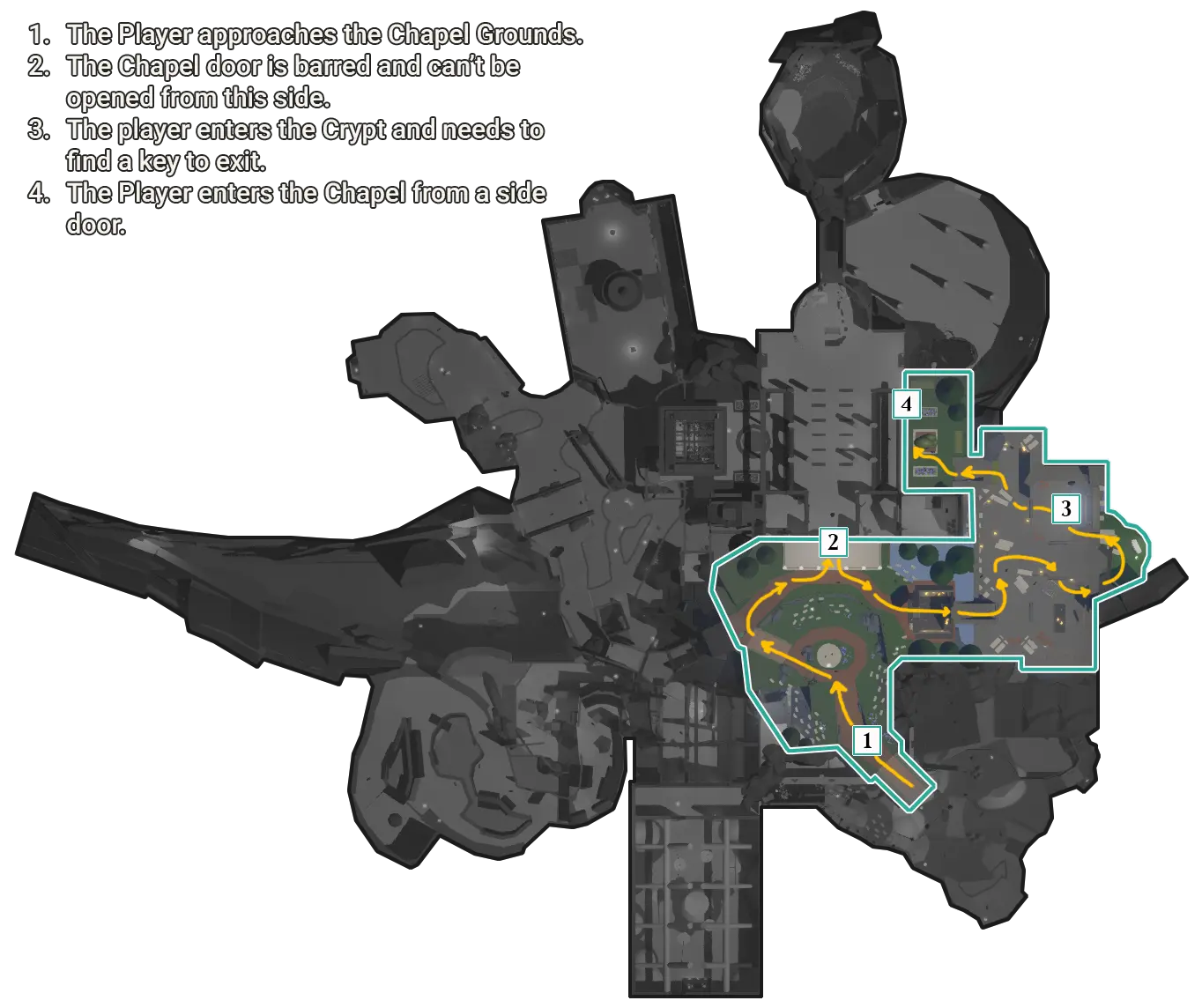
Beat 1: The Arrival
Summary: The player arrives and finds the chapel overrun with the undead. Their goal is to find a way inside and put a stop to the undead infestation. The main entrance is locked, so the only way forward is through an old crypt.
Design Notes: I wanted to let the player know that while doors may be locked in the chapel, there’s always an alternate path that will eventually come back to it. To do this, I have them approach the front entrance, then force them to go through a side entrance to actually unlock the main hall.
The Crypt was designed to introduce elements of the winding layout this level has. Weaving in and out of the structure is a slight callback to Silent Hill 2‘s apartments which use this to turn an ordinary building into a labyrinthe.
Beat 2: A Missing Corpse
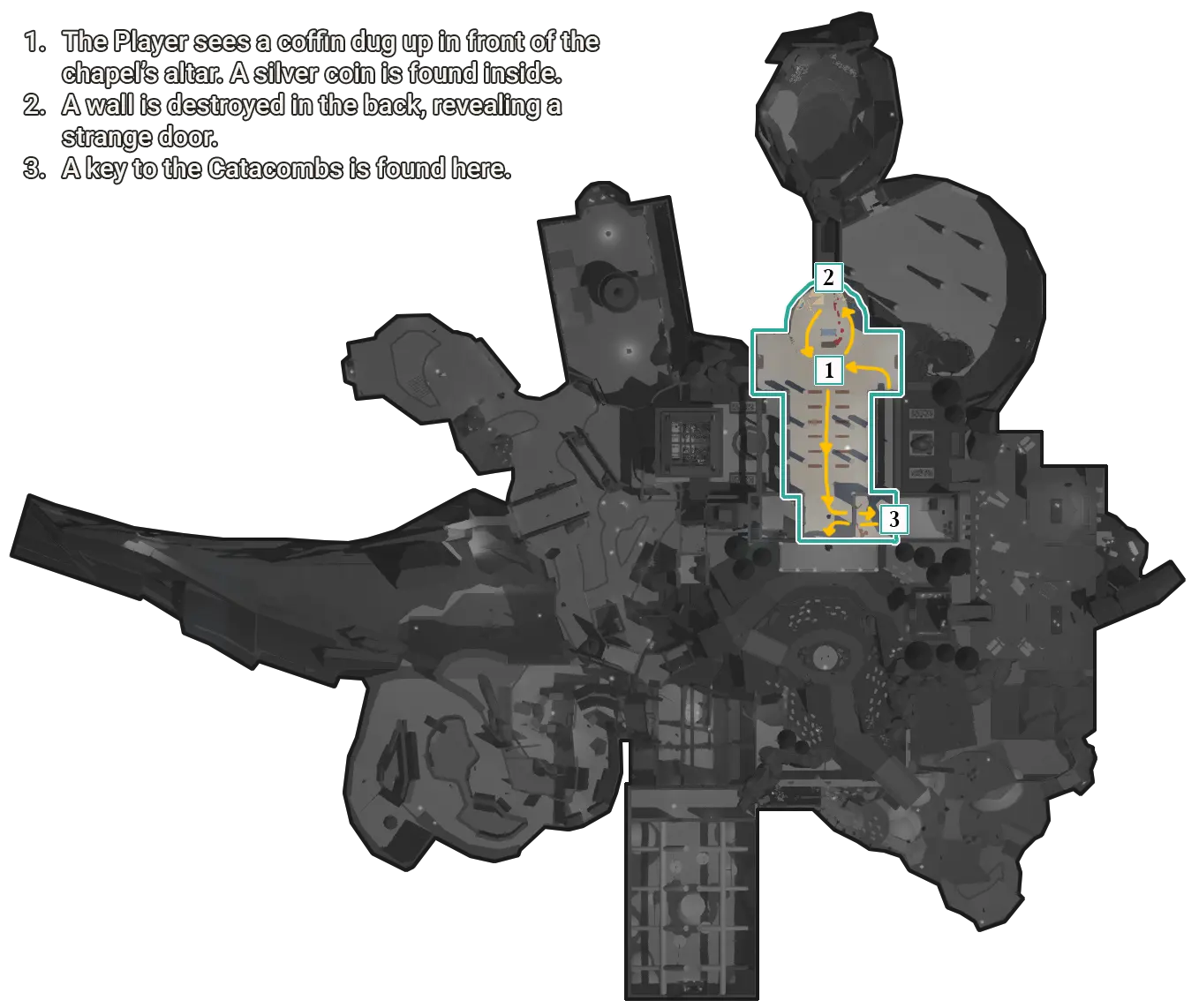
Summary: After the player finds a way into the chapel, they come across an empty coffin that was dug up in front of the altar with a silver coin. A wall behind it was recently destroyed with a suspicious relief that says “Pay the toll, then grab hold of death to travel below.” As players progress through the level, they’ll learn that they must find a silver coin, a gold coin, and a scythe to unlock the door.
Design Notes: I wanted to reinforce to players that this area was special and they would be coming back frequently. As soon as they enter this area, they’re presented with the goal of unlocking this door to see what’s behind it!
Additionally, two of the doors are locked preventing the player from exploring more of the chapel. This is used to indicate that they’ll be coming back eventually and unlocking more of the chapel as they progress.
Beat 3: First Encounter with Court Mage Augus
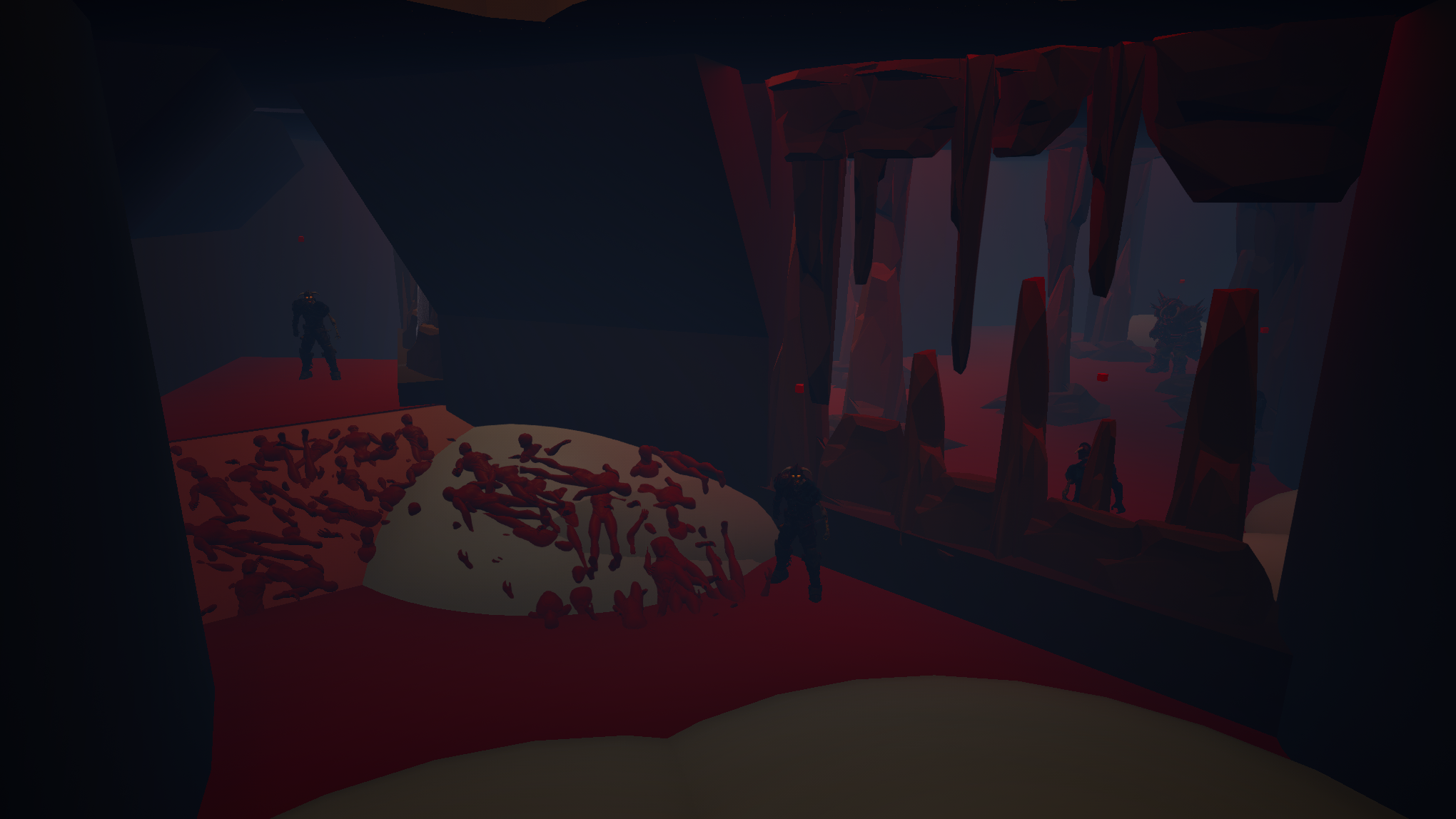
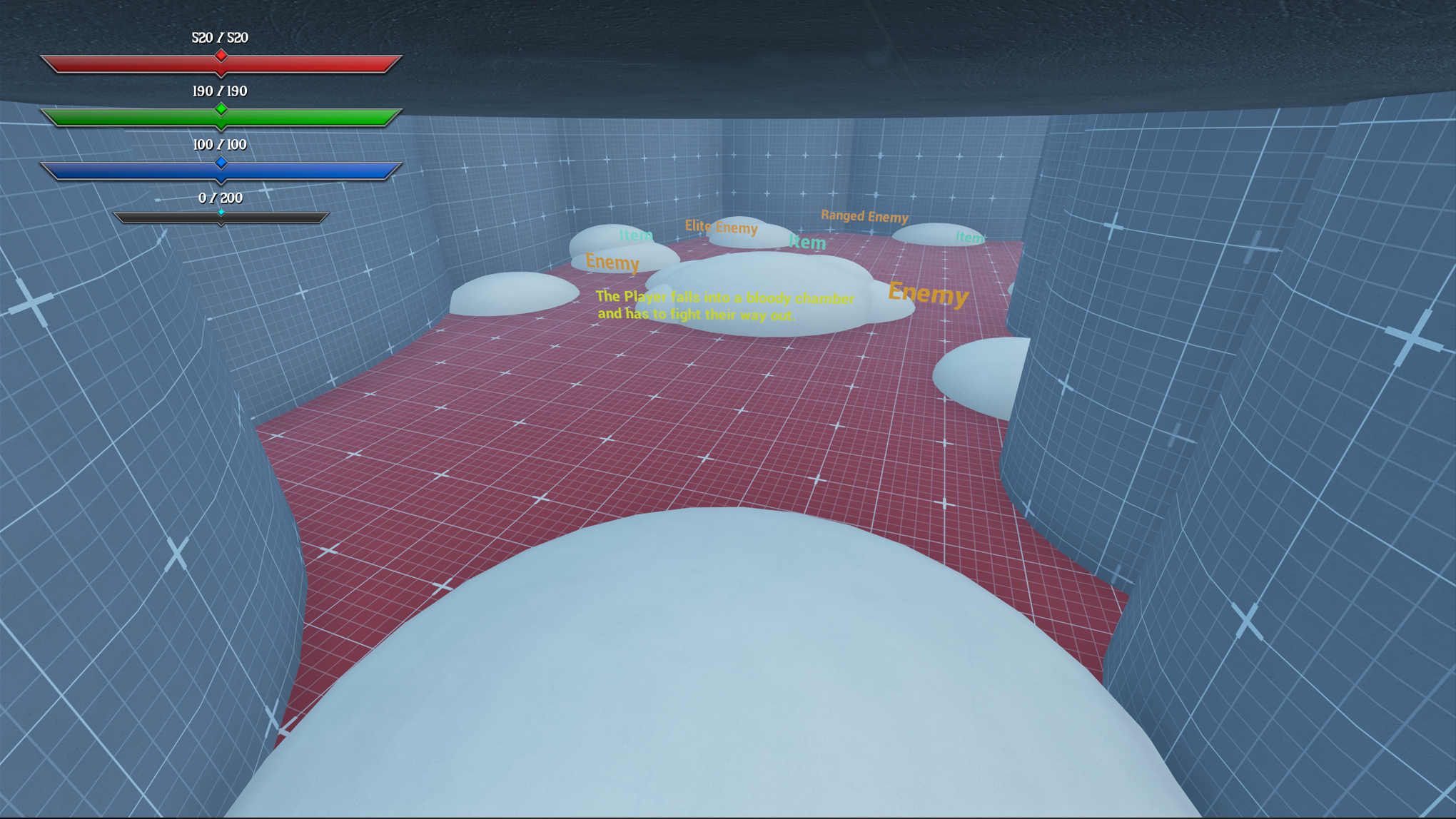
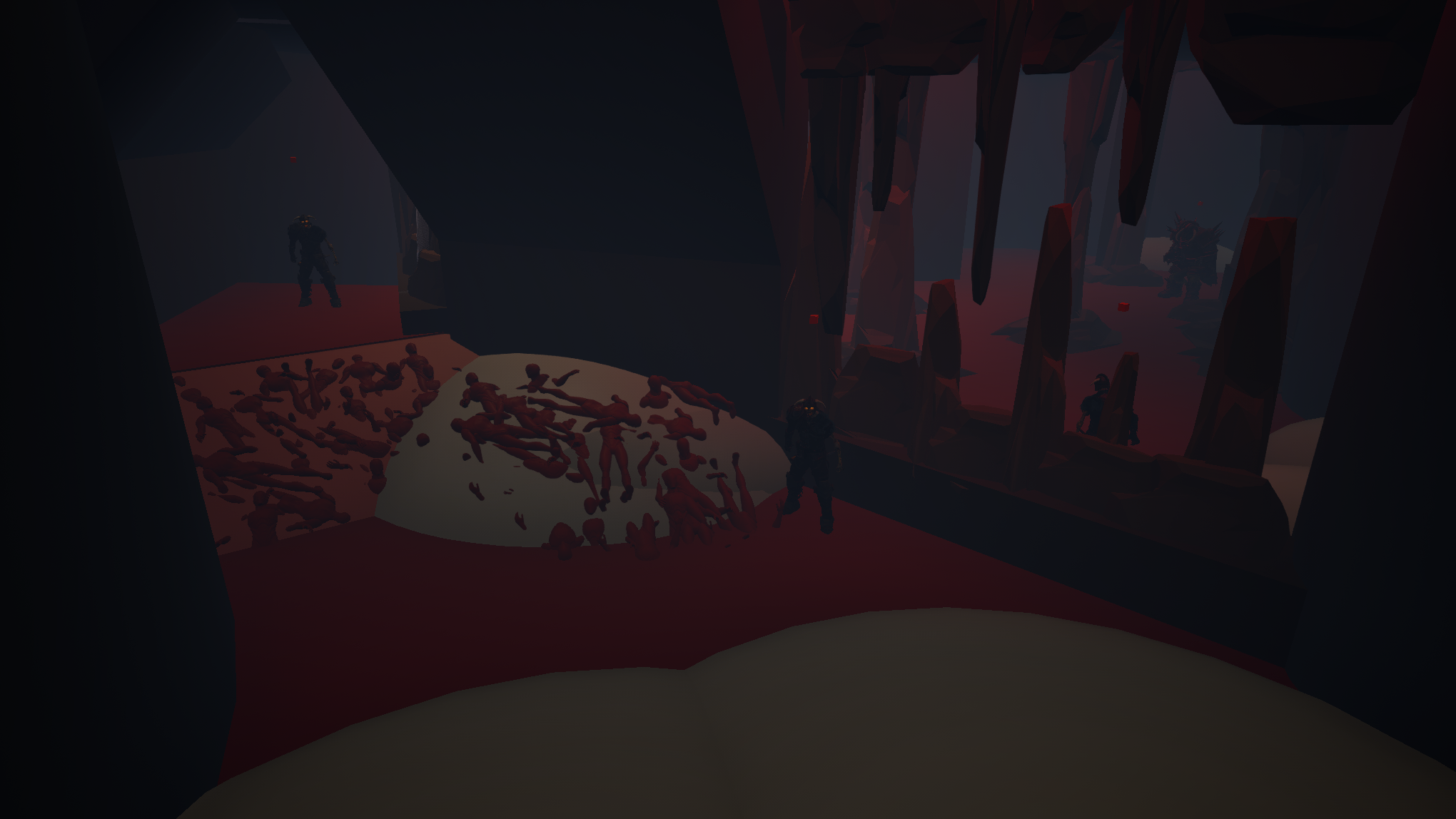
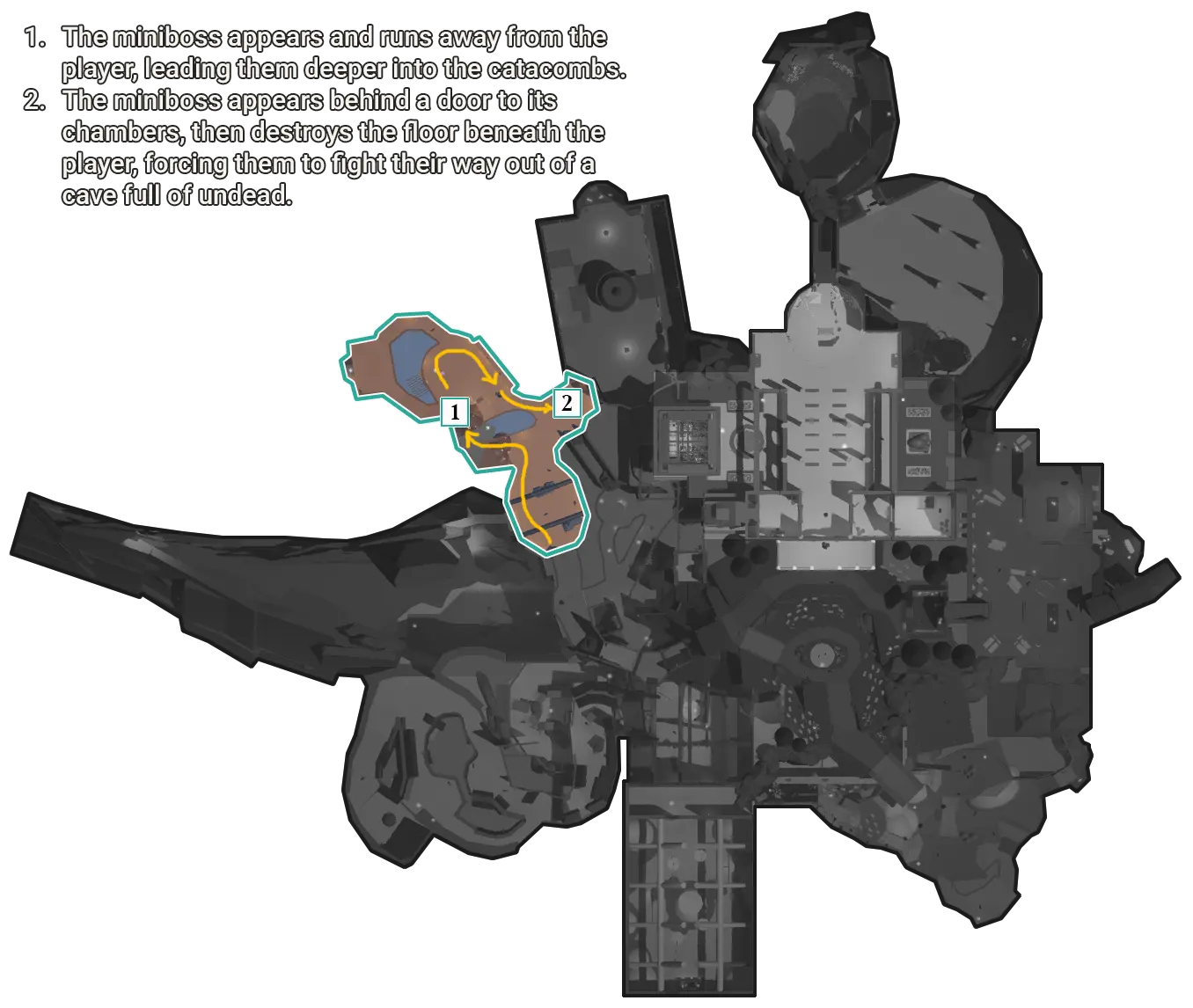
Summary: The player makes their way into the Catacombs and briefly sees the first miniboss, Court Mage Augus, before running off to the side. As the player pursues them, they fall into a cave below on top of a pile of bodies and other viscera. They need to fight their way through enemies and climb out of the cave.
Design Notes: I wanted this area to feel like a catacomb system, but not be too confusing to navigate. I added optional routes that provide a slight combat advantage and item rewards that add to the labyrinthe-like vibe, but always connect back to the golden path.
The section in the cave full of undead was originally just a combat arena. When I saw people playtest this section, they were surprised by the initial pitfall, but the horror didn’t linger. I added a funnel with a scripted event to draw out some more tension from the player and really make this area feel dreadful. See Iteration Highlight 1 below for more details.
Beat 4: First Miniboss
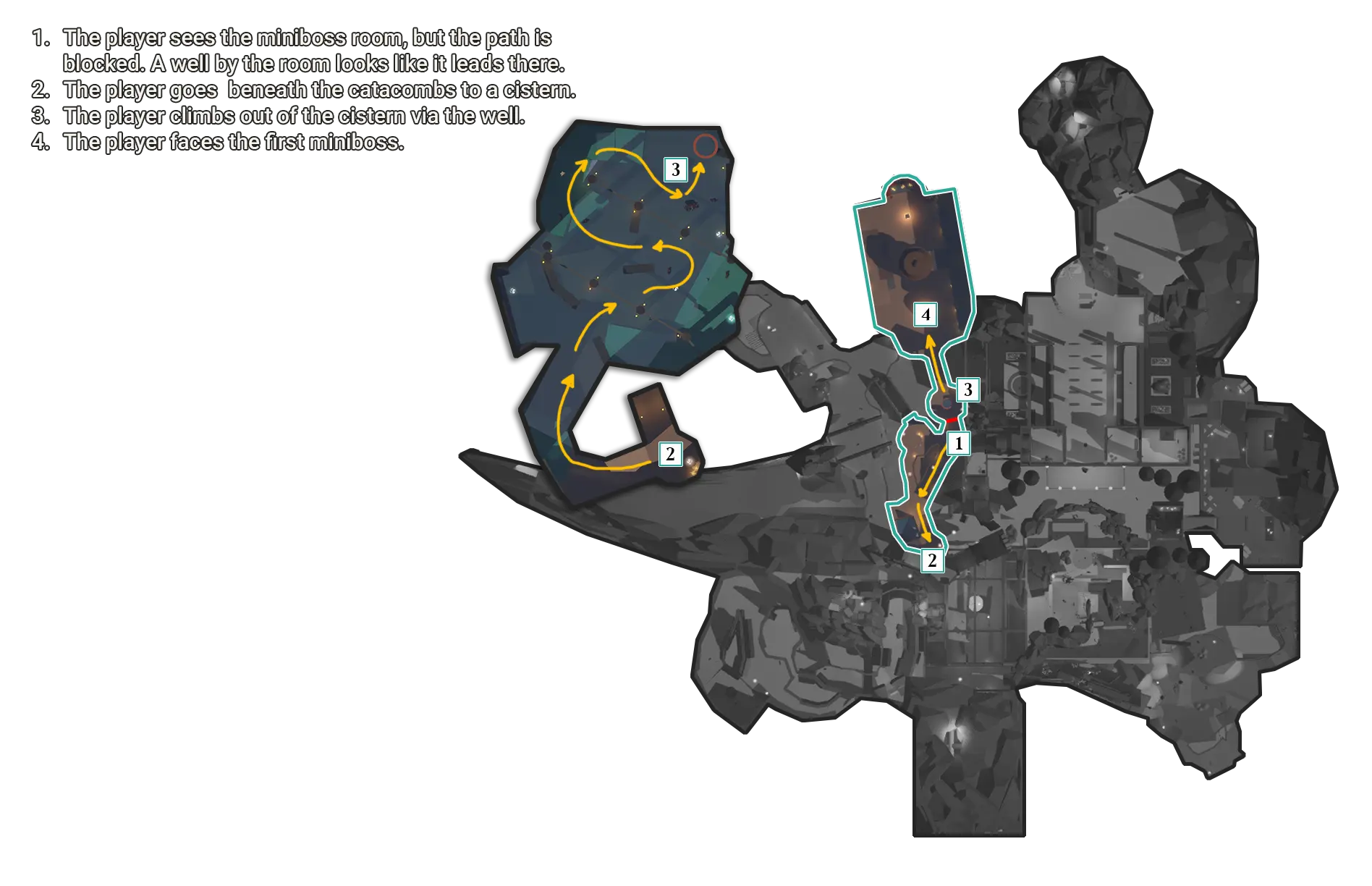
Summary: The player needs to fight their way through an aqueduct below the catacombs, climb out of a well, then face Court Mage Augus. This boss is a ranged boss that summons minions and fires slow moving projectiles. The player loots a coin from its body for the door behind the altar.
Design Notes: I wanted this section to feel like you’re weaving between levels of the catacomb to establish that there’s more beneath the surface. Contrasting the dry caves with a cistern helped break up the feeling of this section and provided visual variety.
The boss arena is designed around a ranged boss that summons extra minions throughout the fight. The arena is actually inspired by DOOM combat encounters because I wanted to give plenty of movement options to engage waves of enemies while dodging projectiles.
Beat 5: Return to the Chapel
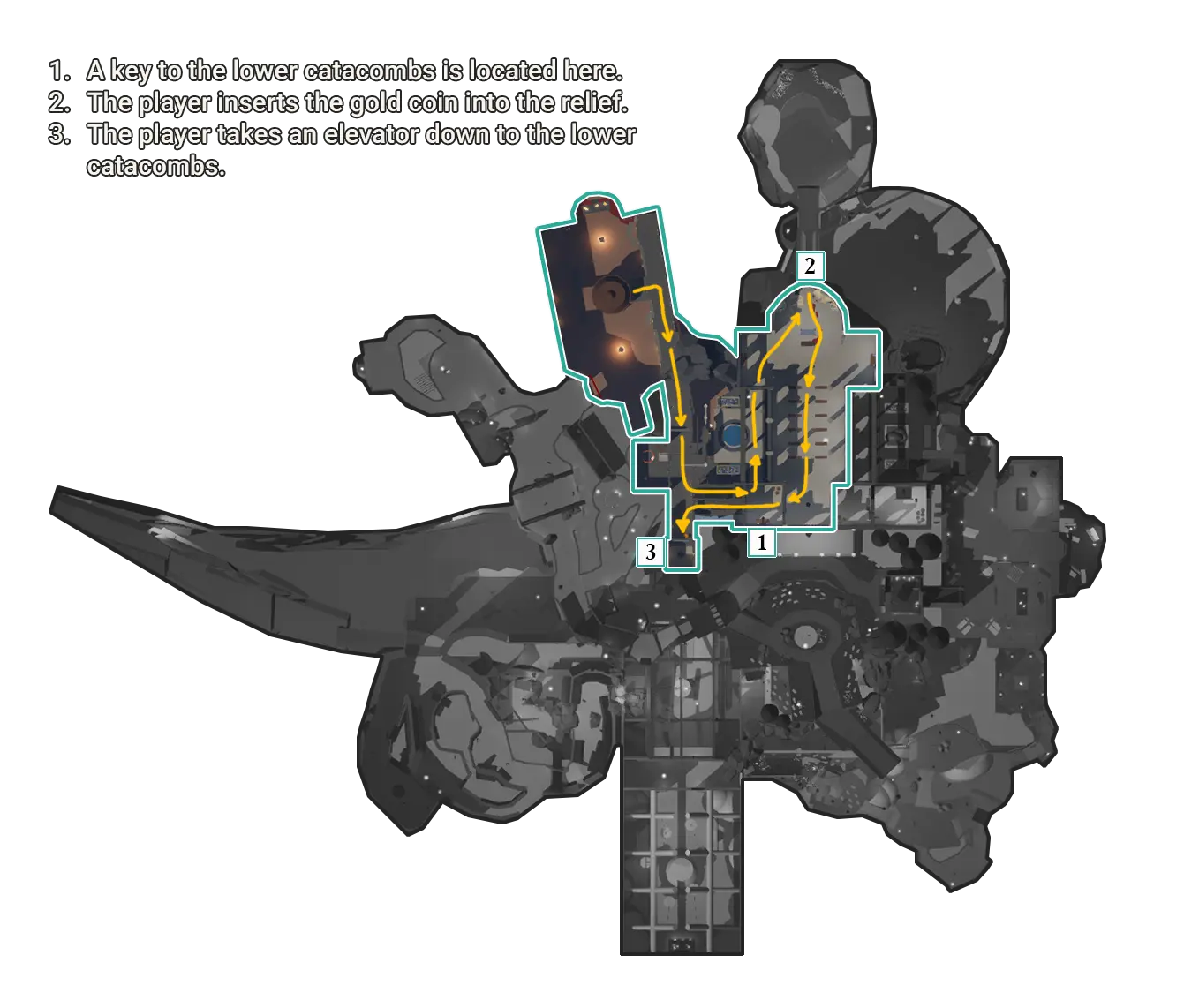
Summary: The player makes their way out of the upper catacombs back to the chapel through its wine cellar. They unlock a shortcut to the main hall and find a locked mausoleum. A key to the lower catacombs is on a table, giving them access to the elevator.
Design Notes: This is the first time you return back to the chapel and I wanted unlocking new areas of it to reinforce that the player is also progressing in the story. The natural lighting in the chapel area also acts as a reprieve from the dark catacomb system players just spent time in.
Beat 6: Lower Catacombs
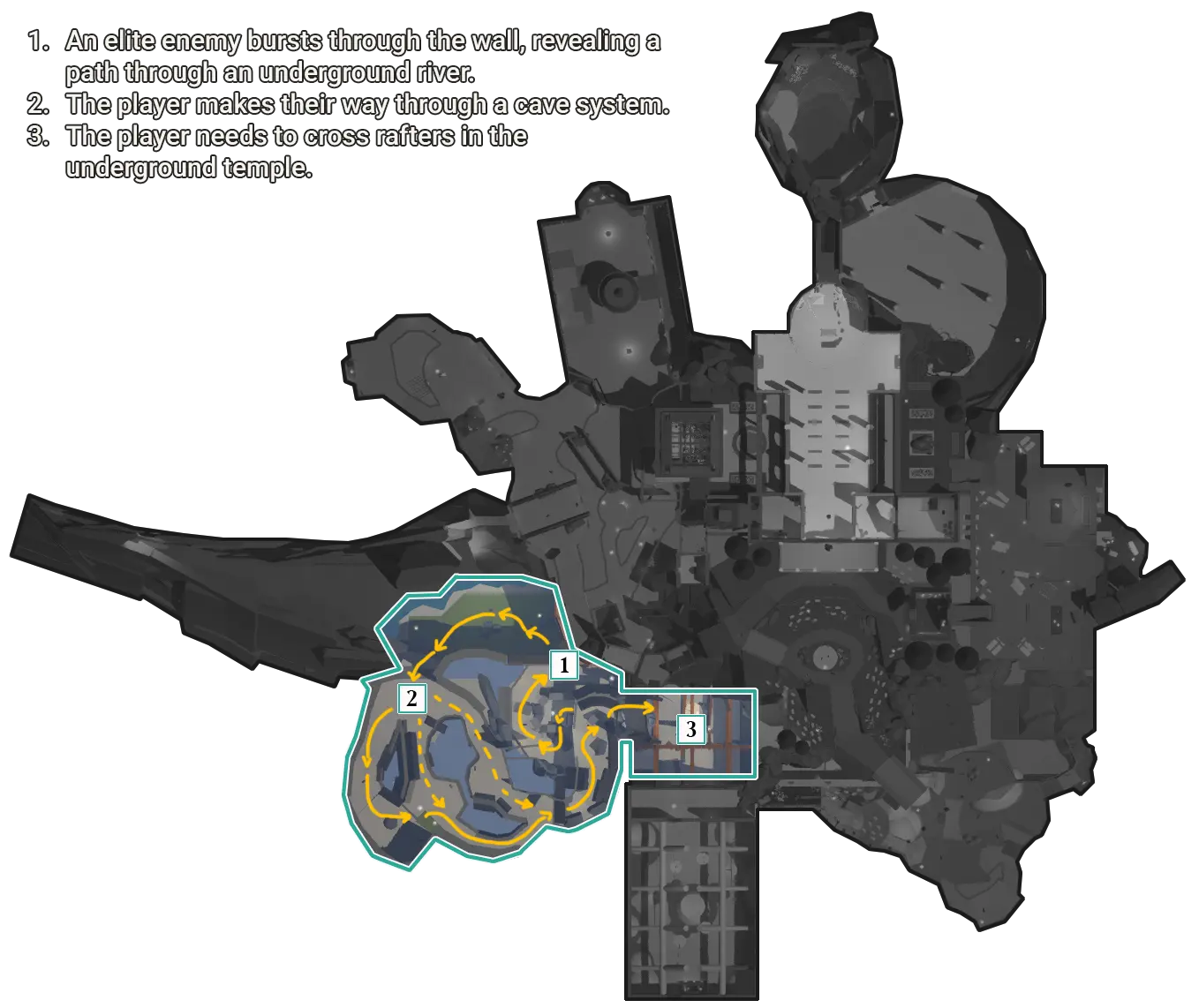
Summary: The player fights through the temple in the lower catacombs. An undead bursts through a wall and reveals a river path in a cave. They make their way through the cave system which connects to the second floor of the temple, where they need to cross old rafters.
Design Notes: This section acts as an intro to the lower catacombs as a whole. You have to maneuver in and out of this underground temple that feels like it’s crumbling as you progress. I thought this would be a nice way to sneak in some visual variety and fun set pieces to surprise the player.
Beat 7: Second Miniboss
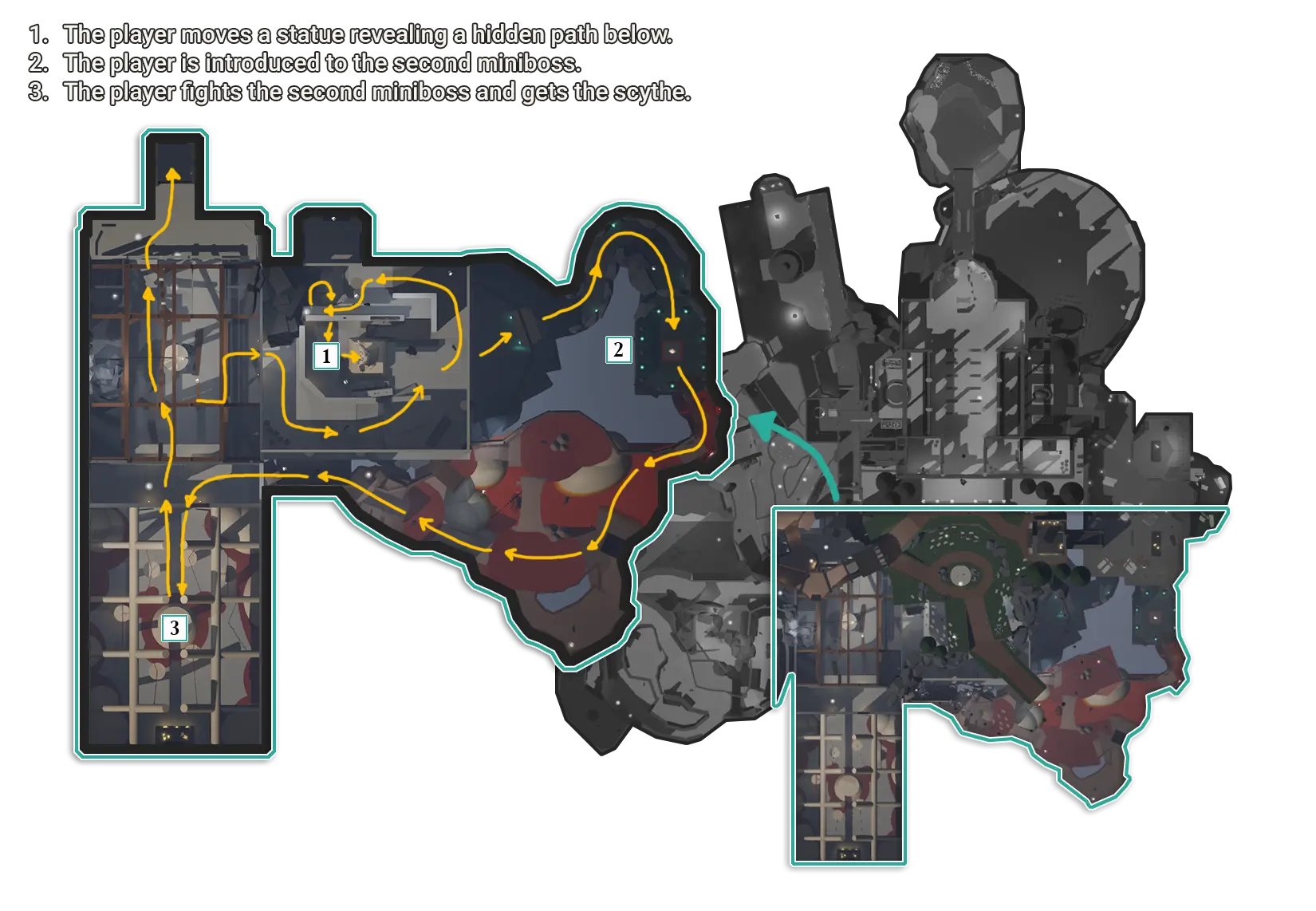
Summary: The player finds the tomb of the second miniboss, General Blackheart, and pulls a lever to enter it. There’s an item acting as a breadcrumb to have the player jump into the darkness, inspired by Silent Hill 2. They enter and have green lights guiding them. They arrive to a sacrificial chamber when suddenly General Blackheart bursts through the back wall and pulls an enemy through. They pursue General Blackheart and slay them getting the final door item, the scythe.
Design Notes: This section wasn’t in my original 2D Map! I added this whole area because I felt that the pacing in this area didn’t do enough to ramp up the intensity towards the second miniboss. This whole section has consistently been players’ favorite because of the scripted events and interesting combat challenges.
Beat 8: The End & the Final Boss
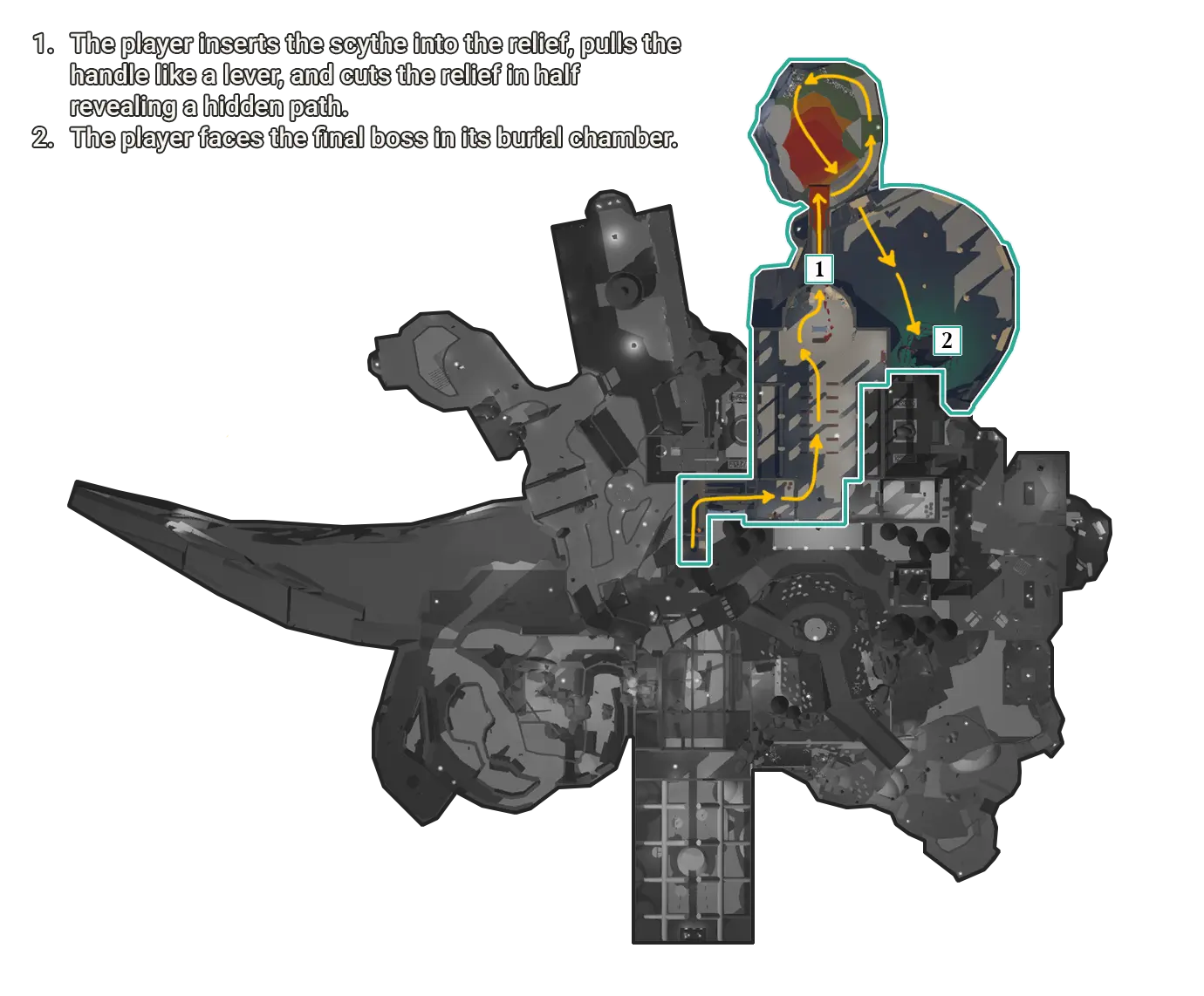
Summary: With the final item to open the door, the player makes their way back to the chapel. They insert the scythe into the stomach of the relief and slice it in half, revealing a blood waterfall and a path to a garden. They enter the final boss arena and fight them! A red ring is dropped.
Design Notes: I really wanted the effort of going through this level and finally unlocking the door to be memorable. With a proper cutscene, having the player rip through the door will look gnarly, but then subvert expectations by revealing one of the most serene areas in the level. The Final Boss arena also plays with elements of both life and death, with fireflies highlighting roots.
Beat 9: Epilogue
Summary: The player makes their way out of the boss arena and can complete the quest. I added an optional area to collect a legendary weapon and provide a little more lore. The red ring dropped by the last boss can be used to open the mausoleum and reveal the queen’s tomb.
Design Notes: I wanted the emotional impact of finding the legendary weapon to be a mix between beautiful and somber. Collecting a weapon from a boss is fun, but I think finding it in a more intimate setting gives it a more personal touch and room for an impactful narrative.
Process Breakdown
Overview
1. Research, Ideation & Planning
I researched various media across video games, movies, architecture, and more to analyze design cues that fit the tone and mood I was going for in this level. The games I researched shaped the level layout, pacing, and structure.
My real world references and other media developed my shape language to make cohesive spaces with distinct sub-zones.
- Analyzing Games: Silent Hill 2, The Witcher, Bloodborne
- Researching Real-World References: Chapelle dans les Bois, Paris Catacombs, Abbey of Thoronet
- Exploring Other Media: The Green Knight, 28 Years Later, Samurai Jack
2. Level Design Document
LDD: I created a level design document to keep track of the overall structure and information of the level. This included:
- Level Objectives
- Narrative and Setting
- Gameplay Mechanics
- Enemy & NPC Behaviors
- Player Interactables
Beat Sheet: I created a beat sheet that outlines each notable encounter and its form of gameplay (e.g. combat, narrative, puzzle). This helped me get ideas on paper and was iterated on throughout the level design process as I thought of more ways to engage the player.
2D Map Layout: I created a rough 2D Map to spatially layout the beats and get an idea for how the different areas would be connected. To make areas more believable, I referenced real world floorplans of catacomb systems and chapels then modified them for gameplay.
3. The First Roughout
Results: Built a full 3D roughout using the 2D map as a reference to test how the scale and layout translated in engine.
Goal: Establish overall size, flow, and layout of the level using only simple shapes.
Implementation/execution:
- Start with the Foundation: I built my roughout only using the floors to save time prototyping a medium scale level. This helped me to quickly test if the layout felt good to play in.
- Changes from 2D: Translating the layered dungeon to 3D space introduced pacing issues due to a long walk back from the lower catacombs back to the chapel. To fix this, I added an elevator to speed up the travel time between the areas.
4. Narrative Pass
Results: Added narrative beats throughout the level to both guide the player and provide more context behind the player’s actions.
Goal: Create a space that tells a story through layout, shape, and written context.
Implementation/execution:
- Level Pacing: I added narrative elements that balanced tension and release.
- Foreshadowing: I added events where the minibosses would appear to increase the anticipation of their encounter.
- Playtest Feedback: Initial playtests revealed the lower catacombs did not provide much tension.
- Playtest Iteration: Further iterations and reviews found that the solve for this was adding in a new combat arena, which helped ramp up the intensity in this section.
5. Enemy Encounters Pass
Results: Created unique combat spaces that have obstacles that feel natural to the world that shape the flow of combat.
Goal: Create spaces to ensure combat flow is clear and engaging.
Implementation/execution:
- Quantity: I analyzed Bloodborne and Dark Souls 3 to understand how many enemies should be in a given space, their placement, and how frequently they appear.
- Flow: I wanted the combat spaces to flow very well, so I combined elements from DOOM (2016) and Lies of P to make “push forward” combat arenas with a strong identity.
- Variety: I balanced each arena around melee, ranged, and elite enemies to make sure each encounter felt like a new puzzle.
6. Scripted Sequences Pass
Results: The scripted sequences I added in helped create moments players can clearly identify when speaking about areas.
Goal: Script custom events that extract an emotional response from the player.
Implementation/execution:
- Short Sequences: I scripted events that introduce the minibosses to the player.
- Traps: I created traps to make players think more carefully about how they traverse the environment.
- Playtest Feedback: I noticed that playtesters ran through one of my combat arenas, when I wanted them to linger in the horror. To keep them in the area, I added a sequence to surprise them and slightly slow them down.
7. Worldbuilding Pass
Results: The extra worldbuilding elements I added made the level feel more like a believable space with a sense of history.
Goal: Add more detail, atmosphere, and story context to make the space feel believable and lived in.
Implementation/execution:
- Boss Arenas: I added visual elements to reinforce each boss’s mechanics and vibe, while not impeding with the space’s flow.
- Light Destruction: Since most of the level takes place in an underground temple, I cut holes in some of the ceilings to reinforce the environment, add context sensitive obstacles, and provide a plausible light source for the dark spaces.
- A Hidden Garden: I added unique flowers that you only see in a specific area of the level as a motif for the first Queen.
8: Key Improvements & Playtesting
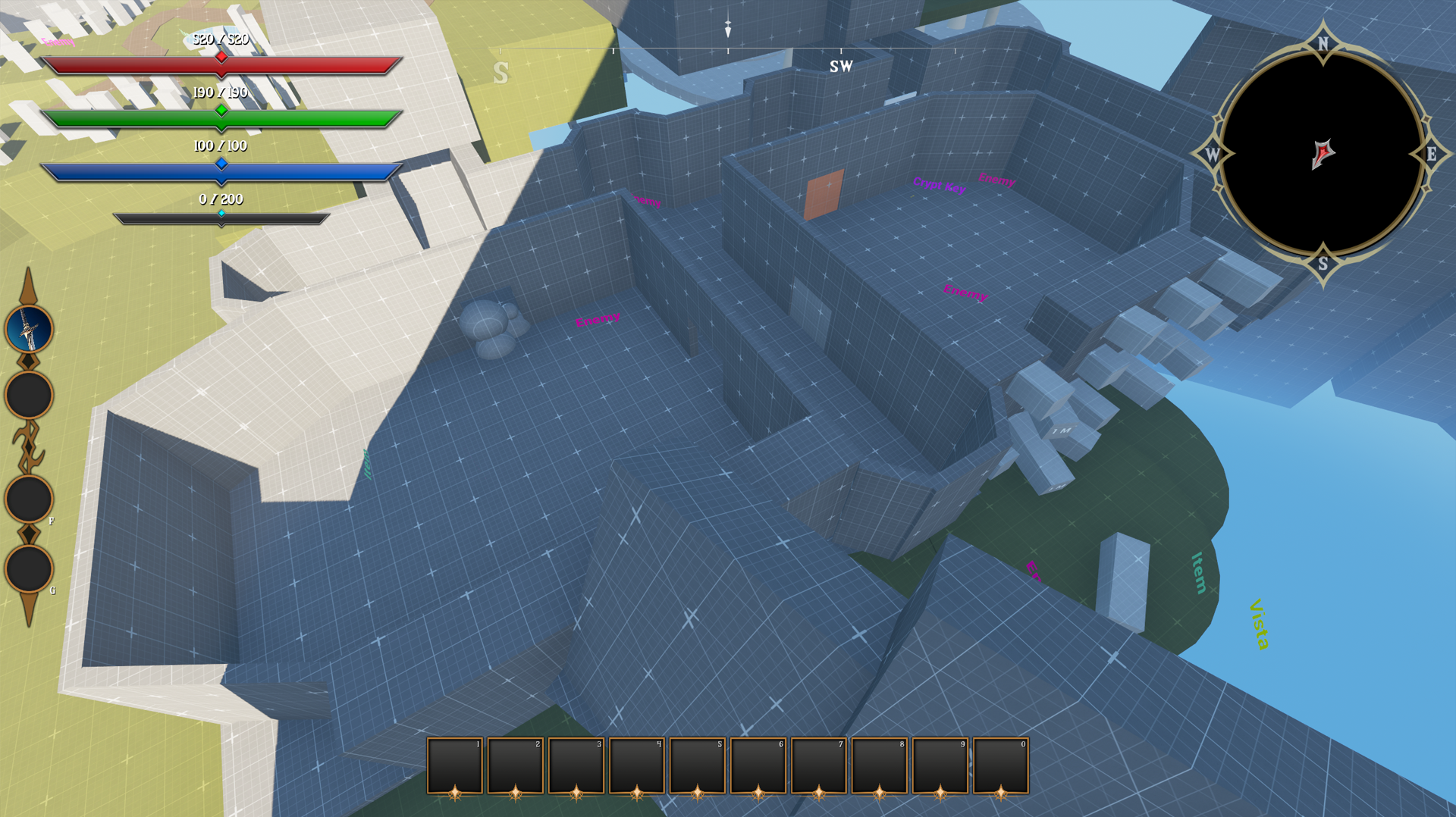
Iteration Highlight 1

Results: I turned this space into one of the more memorable sections of the level that evoked an emotional response from players.
Feedback & Problem: Players rushed through a section that I wanted to have more impact.
Solutions:
- Added immediate danger: Right as you fall into this area, an enemy attacks the player.
- Funnel the player: I added a tight space that bursts with hands of the undead reaching out at you.
- Added more obstacles: I added more columns to make the combat space more engaging.
Iteration Highlight 2

(Brandon Dolinski, Level Designer on Dragon Age: Inquisition)
Results: I made a more engaging and readable combat space that still felt like a dark crypt.
Feedback & Problem: The crypt was difficult to see as a point of interest and the interior felt too narrow to be used as a combat space.
Solutions:
- I turned the entrance into a larger structure.
- I widened the halls and cut the 90 degree corners from some of the hallways to improve sightlines.
- I added obstacles to frame the space and provide a navigation challenge during combat.
Iteration Highlight 3

(Tobias Garsten, Hearthstone / World of Warcraft)
Results: I made a space that surprised players and consistently stated was their favorite area in the level!
Feedback & Problem: The build up to the final boss did not feel like it had a strong enough impact.
Solutions:
- I opted to surprise the player by creating a large open space that’s beautiful in its horror.
- I made the descent to the final boss arena longer, drawing out anticipate and provide the “calm before the storm” moment.
- I framed the final boss arena with a blood waterfall in an underground garden to emphasize the importance.
9. Polish Pass
Results: Areas identified that presented navigation challenges for players were addressed! As a result, the blockout felt like it was in a production ready state.
Goal: Clean up spots that players hesitated in during playtests and help playtesters & artists better understand the design intention.
Implementation/execution:
- Playtest Fixes: Two sections had navigation issues because players had trouble seeing the path forward. I updated the lighting and shifted some geometry to help clear the way.
- Clearer Affordances: I created door arch meshes to more clearly indicate where entrances and exits are.
- Cleaning the Puzzle Door: To help communicate design intent to playtesters, I created the custom door mesh and animation of it spilling out blood when the player opens it after collecting all of the quest items.